A Structural Theory of Modular Biological Oscillations

Leipzig University
Nicola Vassena
Periodic oscillations are central to many biological functions, including metabolic regulation, circadian rhythms, and cell-cycle control. Understanding how such rhythmic behaviors are governed by the structure of the underlying biochemical reaction networks remains a fundamental challenge in systems biology.
The Mochizuki Lab has developed the theory of buffering structures, which identifies subnetwork modules that localize perturbation propagation and thereby explain robustness directly from network topology. This framework also applies to certain bifurcation phenomena, in particular those leading to multistationarity, suggesting how network structure alone can confine qualitative steady-state transitions.
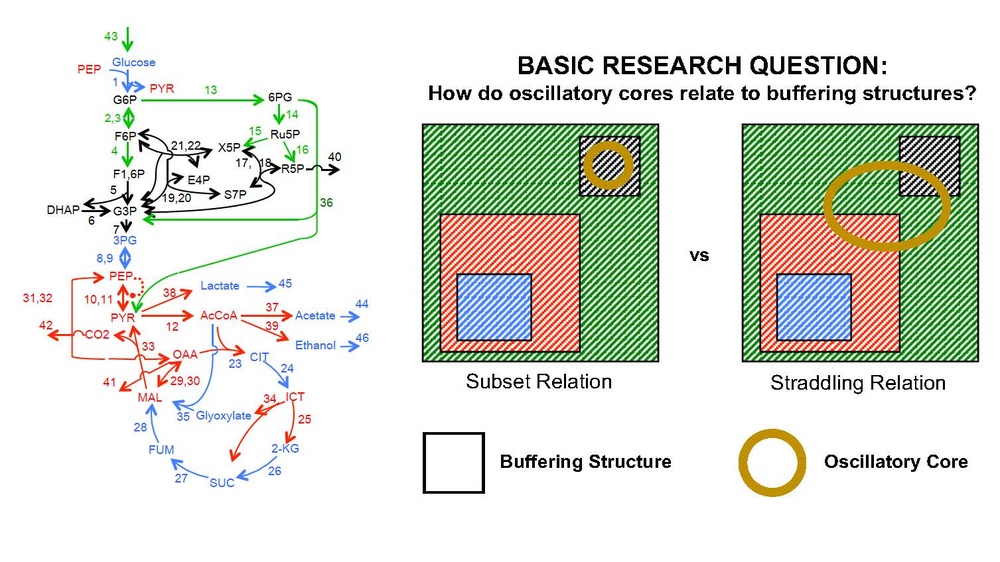
Within a mathematically-consonant structural framework, Dr. Vassena’s recent work has focused on conditions for periodic oscillations in reaction networks. This led to the introduction of oscillatory cores, minimal subnetworks sufficient to guarantee the potential for oscillatory behavior in any network containing them.
Since the bifurcation mechanisms underlying oscillations are complementary to those leading to multistationarity, a natural question arises: how do oscillatory motifs relate to buffering structures and the modular organization of biological networks? This project aims to establish the first systematic connection between these two structural theories, with the goal of determining whether oscillatory behavior is confined within buffering structures or can propagate across them.