
| Oct 08, 2025 Identification of a compound that lowers the cost of human ES/iPS cell culture while enhancing iPS cell generation |
NN15-017 Promotes Human Pluripotent Stem Cell Proliferation and Generation
Regenerative Therapy 30, 838-848.
https://doi.org/10.1016/j.reth.2025.09.003
Shizuka Fujigaki-Yamazaki1, Ryoko Nakatani1, Osamu Hirata2, Koichiro Saruhashi2, Mai Fujii1, Hirofumi Suemori1, Taito Nishino2, and Eihachiro Kawase1
1 Division of Clinical Basis for ES Cell Research, Center for Human ES Cell Research, Institute for Life and Medical Sciences, Kyoto University, 53 Kawahara-cho, Shogoin, Sakyo-ku, Kyoto, 606-8507, Japan.
2 Nissan Chemical Corporation, 2-5-1 Nihonbashi, Chuo-ku, Tokyo 103-6119, Japan.
Abstract
Human pluripotent stem cells (hPSCs) can develop into many different cell types, making them useful in regenerative medicine and disease research. To grow these cells in the laboratory, a substance called FGF2 is required. However, FGF2 is costly and sometimes unstable; therefore, researchers have been looking for alternative compounds that could support stem cell growth.
In this study, we screened a collection of chemical compounds and evaluated their effects on the stem cells. We identified a compound, NN15-017, which allowed us to reduce the amount of FGF2 in the culture medium. The compound also modestly improved the efficiency of creating induced pluripotent stem cells (iPSCs) from normal human cells.
Further analysis suggested that NN15-017 may influence several signaling pathways within cells. These findings may help develop more flexible methods for maintaining and using stem cells, thereby supporting future research in regenerative medicine.
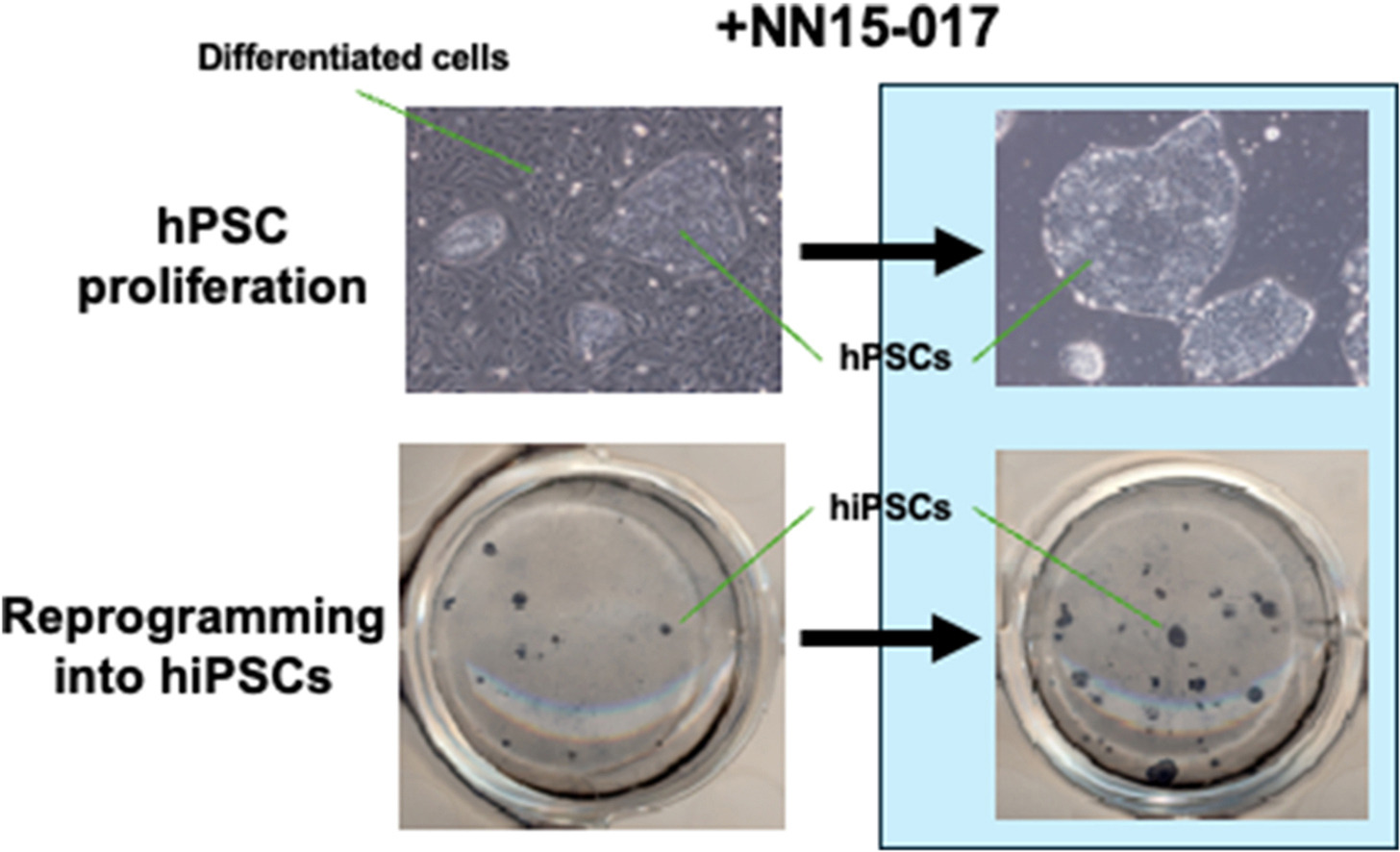
Fig 1: Using NN15-017, a compound discovered in this study, we were able to promote the undifferentiated growth of human pluripotent stem cells and further enhance the efficiency of human iPSC generation.