
DEPARTMENT OF Biosystems ScienceLAB. OF Biological Data Science



Associate ProfessorAlexis Vandenbon

RESEARCH
Integrative analysis of large-scale omics data
Modern molecular biology generates vast, high-dimensional datasets, yet data alone does not yield biological insight. Our laboratory develops computational and bioinformatics approaches to extract meaningful patterns from large-scale datasets, with a particular focus on single-cell and spatial transcriptomics. By integrating diverse omics modalities across tissues and conditions, we aim to uncover the principles governing cellular organization, interactions, and systemic responses in health and disease.
Revealing structured gene expression patterns in large-scale omics data
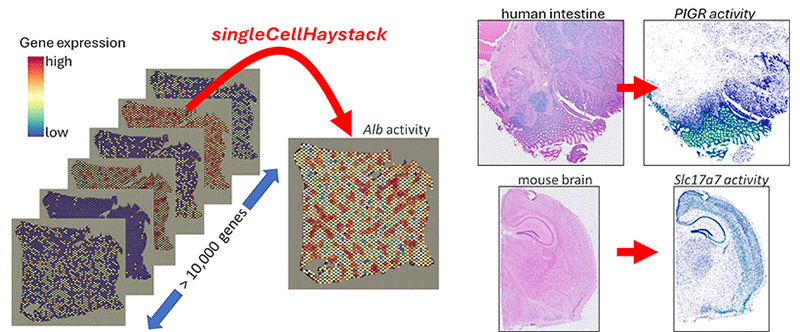
Modern omics technologies generate large-scale gene expression datasets across thousands of genes and samples. While these data contain rich biological signals, it remains challenging to systematically identify meaningful patterns without prior assumptions. To address this, we developed singleCellHaystack, a bioinformatics method for detecting structured gene expression patterns in high-dimensional data, including single-cell and spatial omics (Vandenbon and Diez, Nature Communications, 2020). The identified patterns can be mapped back onto tissues or samples, enabling the discovery of biologically relevant gene activities across conditions. The figure shows representative examples from mouse liver (left), human intestine (top right), and mouse brain (bottom right).
DeepSpaceDB: a platform for accessible analysis of spatial transcriptomics data
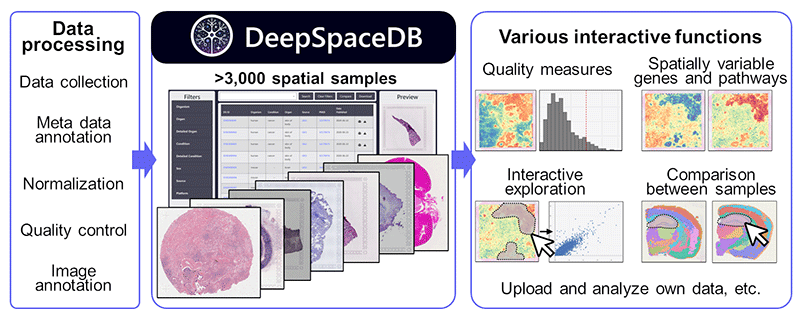
Spatial transcriptomics technologies enable high-resolution mapping of gene expression within tissues, but experiments remain costly and data processing requires substantial computational expertise. As a result, effective reuse and exploration of existing datasets is often limited. To address this, we developed DeepSpaceDB, a database and analysis platform that collects, standardizes, and integrates publicly available spatial transcriptomics data (Honcharuk et al., Nucleic Acids Res. 2026). DeepSpaceDB enables users to explore gene expression patterns, compare samples, and perform interactive analyses through an intuitive interface, without requiring advanced bioinformatics skills. The figure illustrates the data processing pipeline (left), the integration of more than 3,000 spatial datasets (center), and representative interactive analysis functions (right).
TOPICS

2025.11.7
DeepSpaceDB: a spatial transcriptomics atlas for interactive in-depth analysis of tissues and tissue microenvironments
2022.11.2
Development of an in vivo cleavable donor plasmid for targeted transgene integration by CRISPR-Cas9 and CRISPR-Cas12a
2020.9.7
A clustering-independent method for finding differentially expressed genes in single-cell transcriptome data
2018.9.21
Waves of chromatin modifications in mouse dendritic cells in response to LPS stimulation