
| Sep 25, 2026 Independent Control in the Cell Cycle Created by Network Structure —Quantitative Validation of Regulatory Modules Predicted by Mathematics |
Network topology creates independent control of multiple checkpoints in the cell cycle system
Yuhei Yamauchi, Hironori Sugiyama, Yuhei Goto, Kazuhiro Aoki and Atsushi Mochizuki
Proceedings of the National Academy of Sciences of the United States of America
Abstract
For cells to survive, reactions with various functions must occur within the cell, and each must be appropriately regulated. It is known that all reactions within a cell form a single interconnected network, as the products of one reaction serve as substrates for another. But is it actually possible to individually regulate different substances that perform different functions within a single, interconnected dynamic system?
Yuhei Yamauchi, Specially Appointed Assistant Professor, and Atsushi Mochizuki, Professor, at the Institute for Life and Medical Sciences, Kyoto University, along with their colleagues, have previously demonstrated through mathematical theory that when a portion of a reaction network (Note 1) satisfies a certain mathematical equation, it forms a “buffering structure” (Note 2) and acquires “modularity”—the ability to be controlled independently of other parts of the network. In this latest study, through a collaborative effort with Specially Appointed Assistant Professor Hiroki Sugiyama of the Institute for Earth and Life Sciences at Institute of Science Tokyo, Associate Professor Yuhei Goto, and Professor Kazuhiro Aoki of the Graduate School of Biostudies at Kyoto University, the researchers demonstrated that this buffering structure actually exists within the “cell cycle system” (Note 3)—which governs the life stages of cells—and plays a crucial role. Analysis of the cell cycle system suggested that two types of protein complexes, which regulate cell cycle transitions, are contained within different buffering structures and may therefore be controlled independently of one another. Using the latest quantitative analysis, we confirmed that one protein complex indeed behaves independently of the other. Furthermore, by comparing theoretical predictions with experimental verification, we theoretically predicted an unknown reaction and proved its existence through verification experiments.
This research demonstrates that buffering structures—which were previously only mathematical predictions—actually perform important biological functions, thereby updating our understanding of the cell cycle system. Furthermore, a new method in systems biology was proposed, one that derives unknown information as requirements from both theory and experimentation.
The results of this study were published online in the international academic journal Proc. Natl. Acad. Sci. USA September 23, 2026
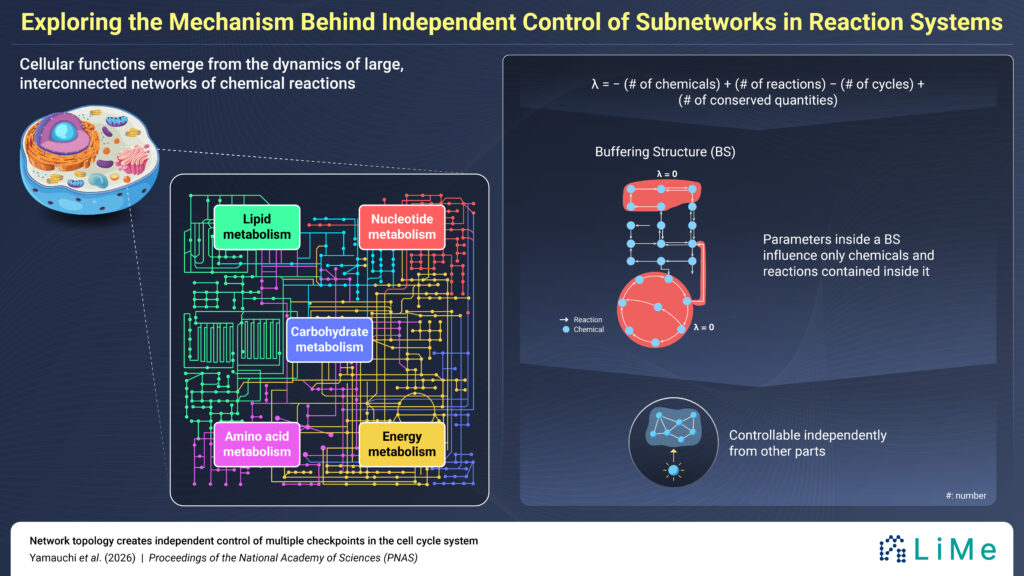
Note 1: Reaction network: A structure composed of chemical species and reaction species, formed by the interconnection of numerous reactions occurring within a cell. It is estimated that the number of different reactions occurring within a cell ranges from several thousand to several ten thousand, and it is believed that all of these are interconnected to form a single network.
Note 2: Buffering structure: A substructure that defines the range of a response, as demonstrated by the “law of localization”—a theory mathematically proving that responses to changes in reaction system parameters are localized, based on structural sensitivity analysis (Note 4). This concept was discovered by Okada and Mochizuki in 2016. Buffering structures are fundamentally determined by local information within the reaction network.
Note 3: Cell cycle system: A reaction network that determines the reaction dynamics of proteins and protein complexes governing changes in a cell’s phase from one division to the next, particularly the critical transitions known as checkpoints.