
| Oct 01, 2026 Step-by-step maturation mechanism of the binary toxin pore revealed by cryo-EM analysis |
Step-by-step maturation mechanism of the binary toxin pore revealed by cryo-EM analysis
Tomohito Yamada1, Ren Nakanishi1, Yukihiko Sugita2,3, Yuki Ninomiya1, Toru Yoshida1, Takeshi Noda2,3, Hideaki Tsuge1
(1Faculty of Life Sciences, Kyoto Sangyo University; 2Laboratory of Ultrastructural Virology, Institute for Life and Medical Sciences, Kyoto University; 3Laboratory of Supramolecular Structural Biology, Research Center for Infectious Diseases, Institute for Life and Medical Sciences, Kyoto University)
Proceedings of the National Academy of Sciences of the United States of America (PNAS) (2026)
Abstract
Associate Professor Yukihiko Sugita and Professor Takeshi Noda, in collaboration with the group of Dr. Tomohito Yamada and Prof. Hideaki Tsuge at Kyoto Sangyo University, resolved the structural changes that lead to pore formation by a bacterial toxin. Using the Ib-rosette, a radial supercomplex formed by Ib, the membrane-binding component of Clostridium perfringens iota toxin, as a handle, the study visualized normally transient intermediates of pore formation as a continuous series of polymorphs and revealed a domino-like, step-by-step maturation mechanism in which the conformational change propagates from one protomer to its neighbor.
For more details, please visit the Kyoto University website.
https://www.kyoto-u.ac.jp/ja/research-news/2026-09-30
This work was partially supported in part by the Joint Usage/Research Center Program of the Institute for Life and Medical Sciences at Kyoto University.
[Comment from the researchers (Associate Prof. Yukihiko Sugita and Prof. Takeshi Noda)]
It is the insight that the group of Prof. Tsuge and Dr. Yamada have built up over many years of work on bacterial toxins that turned the Ib-rosette, an unexpected by-product, into a way through to a phenomenon no one had captured before. Its radial arrangement is reminiscent of the clusters formed by the influenza virus membrane protein, the long-known HA rosette, and the name was taken from there. Bacteriology and virology have developed together as microbiology since their earliest days, and we are glad that specialists from both fields were able to bring this work to fruition using cryo-EM, a technique common to both, at the Institute for Life and Medical Sciences.
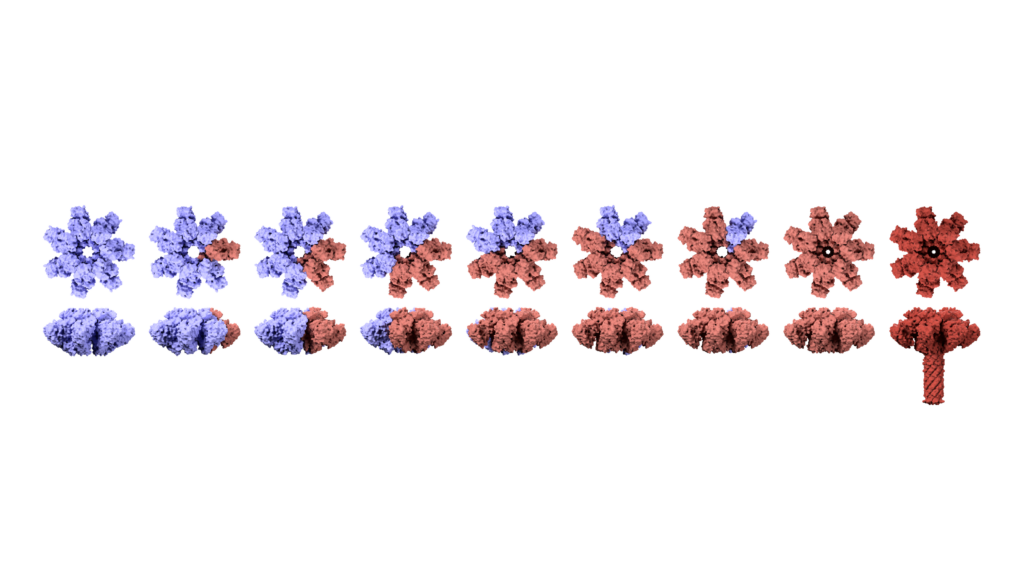
Figure: A series of Ib structures, the membrane-binding component of Clostridium perfringens iota toxin, thought to represent stepwise maturation. From left: eight prepore states and the completed pore.